
How mentally resilient a person is throughout their life depends on many factors: family, school, work, physical health, social connections and personal experiences are constantly interacting. These psychological factors determine whether emotional stress is absorbed – or builds up to become genuine problems. An overview of the key risk and protective factors across the different stages of life.
What Are Psychological Factors?
Mental health does not develop in isolation from one’s environment. Biological factors, personal experiences and social circumstances shape the way we perceive and cope with challenges. It is important to note that such influences do not necessarily lead to mental health conditions. The key factor is the balance between stressors and resources.
Why a stable mind is so important
A stable mental state is the foundation for coping with everyday life, building relationships and dealing with change. If stress is left unaddressed for a long time, it can lead in the short term to sleep disturbances, social withdrawal or a decline in performance. In the long term, it increases the risk of depression, anxiety disorders or substance misuse.
According to estimates by the World Health Organisation, around one in seven people aged between 10 and 19 worldwide is affected by a mental health condition. Mental health conditions are also among the most common health problems in adulthood.
How risk factors and protective factors interact
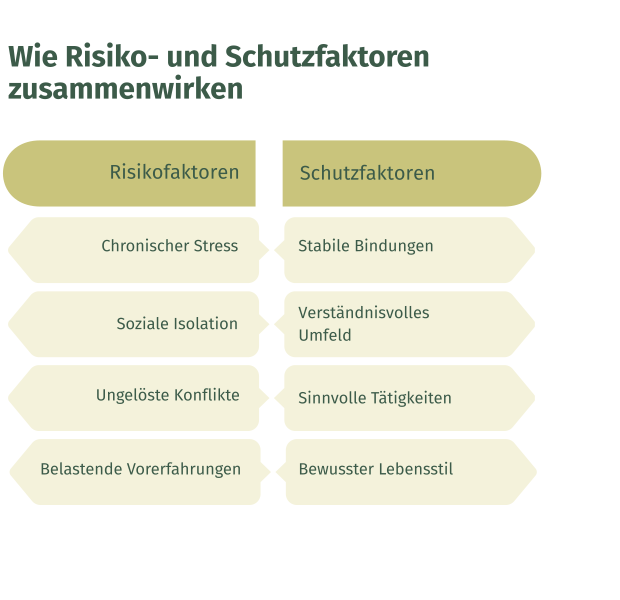
Mental health issues rarely stem from a single cause. Often, several factors combine to bring them about. The most important protective factors include:
- strong bonds with family, friends or other significant others
- a supportive environment at school, at work, in care or amongst friends
- meaningful activities such as sport, music, hobbies or voluntary work
- a healthy lifestyle with plenty of sleep, exercise and periods of rest
If chronic stress, social isolation, unresolved conflicts or traumatic past experiences occur simultaneously over a prolonged period, this can have a noticeable impact on mental stability.
Psychological Factors During Childhood and Adolescence
The foundations for emotional development are laid in early life. Family, school and social experiences shape one’s self-image and ability to cope with stress.
Family environment and experiences of attachment
The family is usually the primary point of reference. It is here that children learn about trust, self-esteem and how to deal with their feelings. Parenting style also plays a part:
- Authoritarian:
Very strict rules and little say in matters can foster self-doubt and anxiety. - Democratic
, clear rules, combined with warmth, build self-confidence and foster healthy relationships. - Laissez-faire
: A lack of guidance can lead to uncertainty and problems in one’s social environment.
Conflicts or a parental separation do not necessarily have to take a toll on mental health – how these situations are dealt with is key. The parents’ own mental well-being also has an impact on family life. Providing support to the whole family at an early stage can help to alleviate the strain.
School, academic pressure and social interaction
School is both a place of learning and a social environment. It can provide support or become a burden.
Common risks:
- The pressure
to perform, exams and high expectations can trigger sleep problems, psychosomatic symptoms or self-doubt. - Bullying
– whether it takes the form of direct hostility or cyberbullying via messaging apps and social media – often takes its toll round the clock. - Exclusion
and being marginalised can encourage withdrawal and undermine self-esteem.
On the other hand, school can also be a safe haven. Recognition from teachers, a strong sense of community within the class, and individual support when pupils are either over- or under-challenged all help children and young people to feel safe and valued.
Digital media: opportunities and risks
Smartphones, social media and computer games are part of young people’s everyday lives. They offer opportunities, but also harbour risks: idealised portrayals on social media can exacerbate self-doubt, whilst long periods spent in front of screens in the evening can disrupt rest and concentration, cyberbullying can persist round the clock, and excessive gaming often leads to isolation – gaming disorder has been recognised as a distinct condition since 2022.
It is helpful to set fixed screen times, discuss content together and deliberately schedule periods offline.
You can find more information on the treatment of children and young people here.
Psychological Factors in Adulthood
In adult life, career demands, family responsibilities and personal life choices often all come into play at the same time.
Career, responsibility and stress
For many adults, everyday working life is a key source of meaning – but at the same time a source of stress. Common sources of stress include:
- A heavy workload
, with tight deadlines and a heavy workload without sufficient time to rest. - Constant availability
; no clear boundaries between work and leisure time. - Lack of appreciation
: Effort goes unnoticed or unrecognised. - Uncertainty
, fixed-term contracts or financial worries.
Prolonged stress without any respite can lead to exhaustion, a feeling of inner emptiness or a sense of burnout.
Relationships, family and social roles
Relationships and family life can provide both support and stress. Unresolved conflicts, an uneven distribution of responsibilities or caring for relatives often lead to chronic tension. Changes in roles – such as becoming a parent or adult children leaving home – are also often associated with emotional adjustment.
Transitional phases and radical changes
Major life events can be particularly challenging for one’s mental well-being:
- Pregnancy and childbirth
often involve a combination of physical, hormonal and emotional changes. - Separation or the loss
of close bonds causes a breakdown; a sense of security is temporarily lost. - Diagnoses
of chronic illnesses often bring about lasting changes to everyday life. - Career changes
: returning to work, leaving a job or taking the step towards self-employment.
When several sources of stress coincide, the risk of developing depression or persistent exhaustion increases. Early support can prevent these symptoms from becoming entrenched.
You can find out more about the treatment of depression in adults here.
Psychological Factors in Later Life
In later life, a wide range of factors come into play – yet some are easily overlooked in everyday life because symptoms are generally attributed to old age.
Loss, loneliness and changes to daily routines
As we get older, our circumstances change. Retirement, the loss of loved ones or the disruption of familiar daily routines can take their toll on our emotional well-being. Loneliness is considered one of the most significant risk factors during this stage of life.
Regular contact with family, friends or neighbours, meaningful activities such as volunteering or hobbies, and a reliable daily routine with fixed mealtimes, exercise and bedtimes all have a stabilising effect.
Physical symptoms and psychological consequences
Physical and mental health are closely linked. Chronic pain, reduced mobility or a diagnosis of a serious illness can lead to feelings of hopelessness or a sense of no longer being needed. Such changes should be taken seriously and not dismissed as normal consequences of ageing.
How Can We Specifically Strengthen Our Mental Well-Being and Health?
Prevention means mitigating stressors at an early stage and consciously promoting protective factors. The following building blocks are effective throughout all stages of life.
Stable relationships and open communication
Trusting relationships are one of the most important protective factors for emotional stability. These include conversations in which concerns are taken seriously, shared routines, and an understanding approach to dealing with conflicts.
Exercise, sleep and a balanced diet
Regular exercise can reduce stress hormones and improve your mood. A balanced diet and sufficient sleep also have a positive effect on mental wellbeing. Whilst such measures are no substitute for professional treatment, they are an effective form of support.
Building and maintaining resilience
Resilience describes the ability to cope with stress without becoming permanently destabilised. It develops in many small steps – through experiences of self-efficacy, problem-solving strategies tried and tested in everyday life, reliable social networks and being mindful of one’s own needs. Resilience can be further developed at any age, whether in everyday family life, at work or in support programmes for older people.
When Is It Advisable to Seek Specialist Support?
Not every difficult phase requires treatment. However, if symptoms persist for weeks, affect several areas of your life or are accompanied by significant limitations, you should seek professional support. At the Verus Libori Clinic, we support you at every stage of life; thanks to our interdisciplinary team, we can address your individual challenges and needs.
Points that should be taken seriously:
- Persistent low mood
lasting several weeks, with no sign of improvement. - Severe anxiety or sleep disorders
that significantly interfere with daily life. - Social withdrawal
; loss of interest in relationships and activities. - Noticeable changes
in eating habits, sleeping patterns or performance. - Distressing thoughts
about one’s own life or that of a loved one.
In such situations, a thorough diagnosis is important in order to understand the underlying causes and to initiate appropriate treatment.
FAQ
Which psychological factors are particularly significant?
There is no single factor that determines everything. Family relationships, social experiences, biological factors, how one copes with stress and individual life circumstances all interact. Which influences have the greatest impact depends on the stage of life and one’s personal circumstances.
Can psychological factors change over the course of a person’s life?
Yes. Protective and risk factors are not static; they change in line with life circumstances. New sources of stress – such as major career changes or bereavements – can pose fresh challenges to mental stability. At the same time, protective factors can be developed or strengthened at any age.
What warning signs should family members take seriously?
The most important signs include persistent changes in mood, social withdrawal, significant sleep or eating disorders, and a noticeable decline in performance. If such changes persist for weeks, it is advisable to speak to a doctor or a specialist counselling service.