Understanding Depression in General
What is meant by depression?
Depression is one of the mental health conditions that affects a particularly large number of people. It can occur at various stages of life and significantly impair everyday life, working life and social relationships. As such, it is not only a burden for the individual affected, but also has major implications for society. The extent to which depression is a significant issue is demonstrated, amongst other things, here:
- Many people suffer from symptoms of depression over a prolonged period.
- Depression is often one of the reasons for absences from work and long-term limitations in everyday working life.
- Personal relationships are also often affected when withdrawal, exhaustion or a lack of motivation alter the dynamics of the relationship.
- Added to this are the significant consequences for the health system and the overall burden on society.
Depression is therefore not just an individual problem. It often affects several areas of life at once, making an early professional assessment particularly important.
What are the typical symptoms?
Depression does not manifest itself in the same way in everyone. Mental and physical symptoms often occur at the same time. Many people affected feel down, listless or emotionally empty over a prolonged period.
Typical signs may include:
- a persistent sense of gloom
- Loss of interest and enjoyment
- severe exhaustion and a lack of motivation
- Sleep disorders
- Changes in appetite
- Difficulties concentrating
- physical symptoms with no clear organic cause
Above all, it is important to consider how long these symptoms last and how severe they are. If they persist for weeks and significantly restrict your daily life, you should seek professional advice.

How causes and risk factors interact
Depression is not usually caused by a single trigger. Often, several factors come together and reinforce one another. These include physical, emotional and social stresses.
Common influencing factors include:
- Biological factors: such as a family predisposition, changes in brain metabolism or hormonal fluctuations
- Psychological factors: for example, intense self-criticism, traumatic experiences or unresolved inner conflicts
- Social factors: such as persistent stress, relationship problems, loneliness or being constantly overwhelmed
- Physical conditions: for example, chronic pain, cardiovascular diseases or neurological disorders
It is often the combination of several stressors that contributes to the development of depression. This makes it all the more important to take symptoms seriously at an early stage, rather than waiting until everyday life becomes almost impossible to cope with.
Does this sound like you? Get in touch with the Verus Libori Clinic and arrange a consultation.
Depression in Early and Middle Adulthood
What health problems are common in young adulthood?
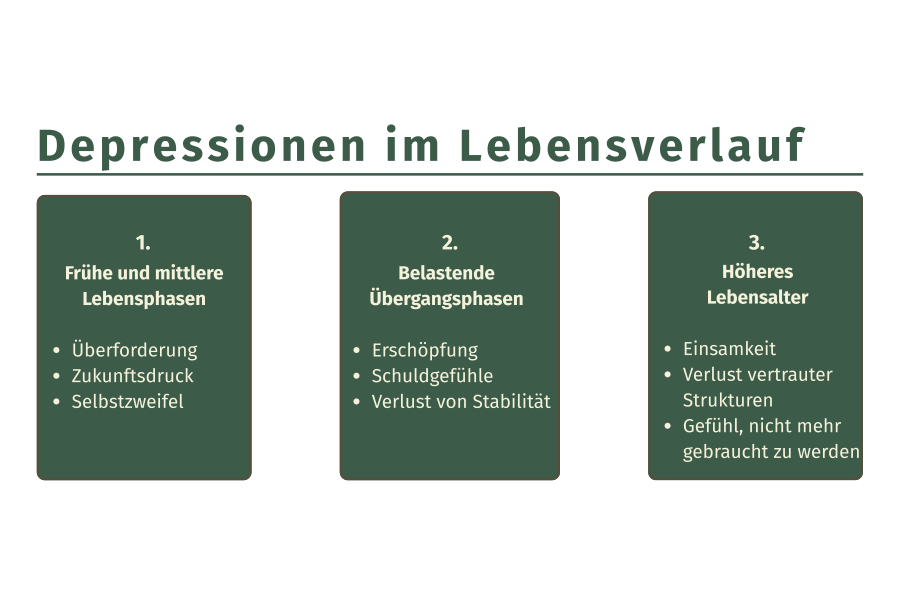
Depressive symptoms are not always recognised straight away in young adulthood. They are often initially dismissed as temporary feelings of being overwhelmed, a sense of disorientation or a reaction to stressful life circumstances. It can therefore be particularly difficult to interpret early warning signs correctly at this stage of life. Typically, the psychological distress develops gradually and has an increasingly significant impact on daily life, performance and future prospects.
How education, starting a career, relationships and life planning can take their toll
Early and middle adulthood are often characterised by high levels of pressure to perform. It is not uncommon for education, starting a career, financial responsibilities, relationships and planning for the future to all coincide. When several sources of stress come together, this can significantly affect mental stability.
Furthermore, many people going through this stage of life feel they have to keep going. Comparing themselves with others, feeling uncertain about their own path, or experiencing conflicts in their personal lives can further exacerbate their sense of stress. This makes it all the more important to have a stable social environment that offers relief, guidance and emotional support.
The situation can also be stressful within the family. Recurring conflicts over school, daily routines or responsibilities can increase the pressure on everyone involved. In the long term, there is a risk that self-doubt, a tendency to withdraw or additional psychological strain may develop.
Psychological and social factors
In addition to external pressures, self-doubt, personal experiences and a lack of stability also play a significant role during this stage of life. Increased vulnerability may, for example, be linked to intense internal pressure, self-doubt, traumatic past experiences or a lack of stability. A lack of support from one’s social circle, insecurity in relationships or persistent stress can also contribute to the development of depression.
The situation often becomes particularly critical when internal pressures and external demands coexist over a prolonged period.
Which treatment options are important during these stages of life
Early treatment is also important during the early and middle stages of life to prevent depressive symptoms from becoming more entrenched. The type of support that is appropriate depends on the severity of the symptoms and the individual’s personal circumstances.
Often, several components come together:
- Psychotherapy: to address distressing thought patterns, inner conflicts and stress factors in a targeted manner
- Medication: if the symptoms are more severe or further stabilisation is required
- Support in everyday life: for example, through clear structures, relief in one’s personal or professional life, and the deliberate establishment of stabilising routines
The aim of the treatment is to reduce psychological distress and to regain a greater sense of security in everyday life.
Does this sound like you? Get in touch with the Verus Libori Clinic and arrange a consultation.
Depression During Stressful Transitional Phases of Adult Life
Why major life changes can take a psychological toll
Major changes in adult life can place a significant strain on one’s mental stability. These include, for example, pregnancy, the birth of a child, a break-up, a bereavement, health issues or major career changes. Such phases are often accompanied by uncertainty, changing demands and increased internal pressure.
Not every stressor leads directly to depression. However, when several factors come together, a transitional phase can become emotionally overwhelming. Typically, familiar routines break down, new responsibilities arise and the sense of security and control diminishes.
The role played by feeling overwhelmed, family responsibilities and inner exhaustion
When depressive symptoms arise during stressful periods of transition, this often creates additional internal pressure. Many people affected experience feelings of guilt because they feel different from what they expect of themselves. Particularly when new responsibilities are added, the emotional strain can intensify further.
Several factors in particular come into play here:
- Physical and emotional exhaustion: chronic sleep deprivation, severe stress or health problems can undermine mental stability.
- Responsibilities in one’s private life: family duties, caring for others and the feeling of having to keep things running often increase the pressure.
- Lack of support: when there is a lack of support from those closest to you, the risk of becoming overwhelmed increases further.
Depression during such stages of life can have a significant impact on one’s well-being and everyday life as a whole. This makes it all the more important to take the signs of distress seriously at an early stage and to seek appropriate support.
Find out more about depression, its symptoms and treatment options.
Depression in Later Life
Signs of depression in older people
Depression in older people often goes undiagnosed for a long time. This is partly because symptoms experienced in everyday life are often attributed to old age, physical limitations or changes in circumstances. This is precisely why it is important to be alert to changes that go beyond a normal stress response.
Examples of such information might include:
- increasing social withdrawal following the loss of close contacts
- a noticeable loss of interest following retirement
- a strong focus on physical symptoms
- a striking sense of hopelessness associated with illness or addiction
- the feeling of no longer being needed
The significance of loneliness, bereavement and physical illness
In later life, loneliness and experiences of loss can significantly increase psychological distress. When close relationships end, social contacts become less frequent or daily life loses its structure, the risk of developing depression increases for many of those affected.
Physical illnesses also play an important role in this. Chronic ailments, reduced mobility or a sense of increasing dependence can place an additional strain on a person. When several of these factors come together, a person’s emotional balance can be noticeably disrupted.
What treatment options are available for older people?
Depression can be effectively treated even in later life. At our clinic, we adopt a holistic therapeutic approach, in which psychological, physical and social aspects are considered together and the appropriate methods are tailored to each individual.
The following are used, amongst others:
- Psychotherapy in individual and group settings: It helps patients to work through distressing thoughts, depressive patterns and difficult life situations in a targeted manner, and to develop new coping strategies.
- Body-oriented psychotherapy: This approach integrates physical and psychological processes and can help you become more aware of tension, exhaustion and inner stress.
- Art therapy: Creative methods can facilitate access to inner psychological processes and provide an additional means of expression when it is difficult to put one’s feelings into words.
- Pain management, supplemented by TCM: It is particularly important in later life to consider mental health issues and physical strain together. For this reason, incorporating pain management may also be beneficial.
Particularly as people get older, it is crucial to tailor treatment to their personal circumstances and individual symptoms.
FAQ
How can you tell whether persistent low mood requires treatment?
The key factor is whether symptoms persist over a prolonged period and significantly interfere with daily life. If feelings of low mood, a lack of motivation, loss of interest or inner exhaustion do not subside after a few days but continue to be noticeable over a period of weeks, a professional assessment should be sought. Depression is generally treatable, although the duration of treatment can vary considerably from person to person.
Can depression manifest itself differently at different stages of life?
Yes, depressive disorders can manifest themselves differently depending on the stage of life and can also be experienced differently. At the same time, it is true that depression can, in principle, occur at any stage of life. The most appropriate treatment therefore always depends on the individual’s symptoms, their personal circumstances and the severity of their condition. Psychotherapy is a key pillar of treatment; medication may also be useful as a complementary measure, depending on the severity of the condition.
What role do exercise and daily routine play in depression?
Physical activity and structured routines can provide valuable support for treatment. Physical activity can have a positive effect on mood, sleep and general well-being; for less severe cases of depression, exercise programmes are also recommended as a complementary measure. At the same time, it is important to note that, in cases of depression, exercise alone is no substitute for professional treatment, but should be seen as a supportive element.