An Introduction to Building Resilience
Resilience is so important for mental health because it helps us to cope better with stress, change and difficult periods. In everyday life, this is evident, for example, in how well we manage to remain mentally flexible in stressful situations, regain our stability after crises and draw on sources of support.
What does resilience mean?
Resilience refers to the psychological strength that enables people to cope in stressful situations. It is not characterised by crises passing without leaving a trace, but rather by the fact that recovery, adaptation and a new sense of direction remain possible. How well someone copes with difficult experiences depends both on their personal circumstances and on their environment.
Why resilience is important for mental health
Stress cannot always be avoided. This makes it all the more crucial to be able to cope with pressure, uncertainty or emotional crises in such a way that they do not lead to long-term overwhelm. Resilience can help with this,
- Understanding stress better
- to remain capable of taking action during difficult times
- to find a firmer footing again after difficult experiences
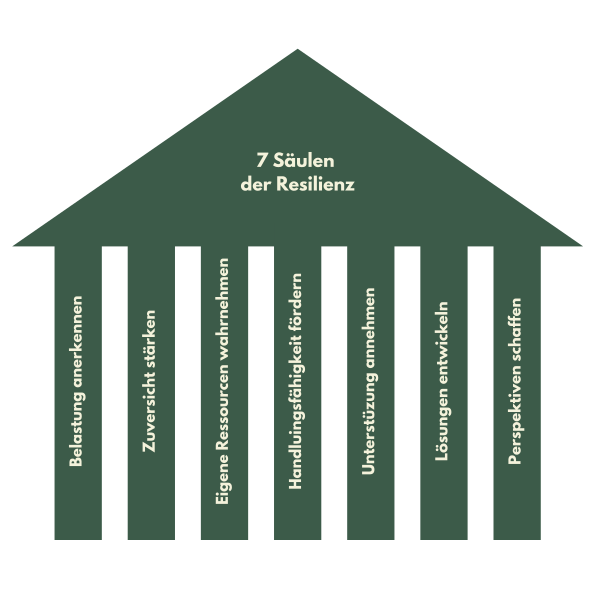
Which Everyday Factors Can Help Build Mental Resilience
In everyday life, there are various factors that can help build psychological resilience. These include, above all, a sense of security, reliable structures and a supportive environment. Such factors help us to cope better with stress and to maintain our inner stability during difficult times.
Safety, reliability and guidance
Security, reliability and a sense of direction are key foundations for psychological resilience. If everyday life is not merely experienced as unpredictable or overwhelming, but also contains predictable and reassuring elements, this can provide a sense of relief. Particularly during difficult times, it is helpful if not everything seems uncertain at once.
It is not just a question of external circumstances. Subjective experience also plays a part: those who are better able to make sense of situations and do not feel constantly overwhelmed by unpredictability often find it easier to regain their inner peace.
Social relationships and supportive environments
Social relationships can also have a noticeable impact on mental stability in everyday life. Not every source of stress can be avoided, but a supportive environment can help ensure that difficult situations are experienced as less isolating and less overwhelming.
The following are often particularly helpful in this regard:
- Reliable support figures
. They provide stability and give you the feeling that you are not alone in dealing with difficulties. - Empathetic responses in everyday life
People who feel seen and taken seriously are often better able to cope with stress. - A sense of belonging and social integration
Experiencing a sense of community can help to mitigate feelings of isolation and being overwhelmed.
Therapeutic Approaches to Building Resilience
Resilience can be specifically fostered not only through everyday life but also through therapy. At the Verus Libori Clinic, various methods are used to this end, which can help patients improve their ability to cope with stress, build inner stability and develop new coping strategies. For adults, options include psychotherapy, individual and group therapy, creative approaches and complementary therapies; for children and young people, the range of services also includes psychotherapeutic and body-oriented approaches.
Find out more about the treatment methods for children and young people at the Verus Libori Clinic.
Systemic therapeutic approaches
Systemic approaches focus not only on individual sources of stress, but also on the environment in which people live. Relationships, communication and recurring patterns can have a major influence on how stress and crises are dealt with. This is precisely where systemic work can make a difference: it helps people to better understand dynamics, shift their perspectives and become more aware of supportive structures.
Cognitive Behavioural Therapy and Resilience
Behavioural therapy approaches can help people to recognise distressing thought patterns and make targeted changes to the way they deal with difficult situations. This is particularly important for building resilience, because internal judgements and habits often play a part in determining whether stress is experienced as permanently overwhelming or whether a person regains a greater sense of agency.
In therapeutic work, this may, for example, involve,
- to become more aware of stress-inducing thoughts
- to gradually change unhelpful reaction patterns
- to develop greater confidence in dealing with stress
Mindfulness-based approaches
Mindfulness-based techniques can help you recognise tension at an earlier stage and manage stress in a more conscious way. Complementary therapies such as stabilisation, relaxation, yoga and mindfulness techniques are an important part of building inner strength.
Such approaches can strengthen resilience because they help people to stay in the moment, regulate inner restlessness and avoid the need to immediately suppress their feelings. Particularly when used alongside other therapeutic methods, they can help people to develop greater calm, self-awareness and inner stability.
Find out more about the treatment methods available at the Verus Libori Clinic.
How Can Emotional Strength Be Specifically Nurtured?
A key component of building resilience is the development of emotional strength. This is reflected in the ability to recognise and make sense of one’s feelings more effectively, and to remain capable of taking action in stressful situations.
- Emotional coping strategies
: Those who learn to deal with anxiety, uncertainty or frustration in a more conscious way are less likely to be overwhelmed by distressing emotions. This helps them to remain calmer even in difficult moments and to look for solutions. - Self-efficacy and confidence in one’s own abilities
The feeling of being able not only to cope with challenges but also to influence them strengthens psychological resilience. It is precisely this confidence in one’s own ability to take action that forms an important foundation for dealing with stress more effectively.
In this way, emotional strength becomes an important foundation for long-term resilience.
Practical Exercises to Build Resilience
In everyday life, there are many small situations in which resilience can be strengthened. Often, it is not the individual exercise that is crucial, but rather that helpful ideas are taken up regularly and incorporated into one’s daily routine. In this way, more stable inner patterns can gradually develop.
Making conscious use of everyday situations
Everyday challenges can help to build one’s resilience. This is particularly true when difficult moments are seen not just as disruptions, but also as opportunities to become more aware of how we deal with frustration, uncertainty or pressure.
Examples of helpful everyday situations might include:
- Minor setbacks
offer the opportunity to develop a new way of dealing with disappointment. - Unplanned changes
can help to foster inner flexibility. - Stressful moments throughout the
day often reveal which reactions provide relief and which add to the pressure.
Rituals and routines to promote resilience
Fixed rituals and reliable routines can provide a sense of stability and direction. Particularly during stressful periods, it helps if not everything in daily life seems unpredictable. Recurring habits create structure and can therefore be a source of relief.
These can be all sorts of things, such as a peaceful start to the day, regular breaks or small, recurring moments of respite. Routines like these provide a sense of stability and can help to reduce inner tension.
Creative forms of expression for emotional processing
Creative forms of expression can help us process our feelings in a different way. They create space for things that cannot always be put into words straight away, and can make it easier to cope with inner tension.
The following are often particularly accessible:
- Drawing or painting
can bring feelings and impressions to life without having to explain them straight away. - Writing
Thoughts and inner reactions can often be organised more clearly when they are written down. - Creative pursuits
can help relieve stress and reinforce the sense that you are actively doing something to counteract it.
At the Verus Libori Clinic, we use a range of creative therapeutic methods, such as art therapy.
Conclusion: Building Resilience in the Long Term
Resilience is not developed through individual measures, but primarily through experiences that repeatedly provide support, guidance and self-confidence in everyday life. This is precisely why it makes sense not only to apply helpful strategies in the short term, but also to integrate them into one’s own life step by step.
Sustainable ways to build inner strength
Above all, approaches that can actually be put into practice in everyday life are effective in the long term. These do not involve perfect routines, but rather reliable elements that provide guidance even during stressful periods.
Important factors here include, for example:
- Regular routines that provide a sense of stability
- deliberate moments of respite to prevent feeling overwhelmed
- an approach to coping with stress that focuses on awareness rather than repression
- social connections that provide understanding and support
- small successes that boost confidence in one’s own ability to cope
Resilience as an ongoing process
Resilience is not a fixed state, but one that continues to develop. The demands placed on it can vary depending on one’s stage of life, the pressures faced and one’s personal circumstances. This makes it all the more important not to view psychological resilience as something static, but as a process that constantly requires new adaptations and new ways of stabilising oneself.
FAQ
How long does it take to noticeably strengthen resilience?
There is no one-size-fits-all answer to this. The first signs of change may become apparent after a while in everyday life, for example in how one deals with stress, uncertainty or setbacks. However, building resilience in the long term usually happens gradually and requires time, repetition and the right conditions.
What everyday factors can help improve mental health?
Factors that promote a sense of direction, relief and inner security are particularly helpful. These include, for example, reliable structures, supportive relationships, deliberate rest and relaxation in everyday life, and a way of dealing with stress that is not solely focused on simply getting by. Which elements have a particularly stabilising effect can vary from person to person.
Can resilience still be developed later in life?
Yes, psychological resilience can continue to develop over the course of a person’s life. It is not a fixed trait, but is shaped by experiences, how one copes with stress, and supportive influences. That is why resilience can still be strengthened later in life — for example, through new coping strategies, therapeutic interventions and practical changes to everyday life.